Department of Mathematics

- Introduction
- Vision
- Mission
- Programs Offered
The Department of Mathematics at the University of Narowal is dedicated to the scientific study of mathematical structures, patterns, and their applications to real-world problems. The department offers comprehensive programs at multiple levels, Bachelor of Science (BS), Master of Philosophy (MPhil), and Doctor of Philosophy (PhD) designed to provide students with a deep understanding of both theoretical and applied aspects of mathematics.
The BS Mathematics Program is offered under the Faculty of Science and enables students to explore fundamental mathematical concepts including algebra, calculus, geometry, linear algebra, and discrete mathematics. The program emphasizes advanced domains such as Pure Mathematics, Applied Mathematics, Computational Mathematics, and Mathematical Physics. With a total of 134 credits spanning eight semesters over four academic years, the BS program integrates scientific foundations with practical applications in technology, engineering, economics, and data science, preparing graduates for professional training and advanced studies.
The MPhil Mathematics Program is designed for students seeking advanced specialization and research training. Comprising 32 credit hours over four semesters, the MPhil program combines taught courses (26 credit hours) with a substantial thesis component (6 credit hours). Students engage with 10 compulsory courses including advanced topics in numerical analysis, integral equations, differential geometry, topology, linear algebra, and computational methods, along with specialized electives. This program prepares graduates for academic careers in universities, research organizations, and professional sectors requiring advanced mathematical expertise.
The PhD Mathematics Program represents the pinnacle of mathematical research and expertise, spanning 50 credit hours over seven semesters. With 20 credit hours of taught subjects and 30 credit hours dedicated to original research culminating in a comprehensive thesis, the PhD program develops leading researchers and scholars. Students undertake specialized coursework in advanced differential equations, partial differential equations, boundary value problems, advanced mathematical techniques, and emerging fields such as bio-fluid dynamics, stochastic differential equations, and fuzzy fractional differential equations. Additionally, electives cover cutting-edge areas including geometric topology, modular forms, cryptography, machine learning, dynamical systems, and advanced mathematical modeling.
The overall aim of the department is to integrate scientific foundations of mathematics with practical applications while fostering innovation and research excellence. This integrated approach prepares students across all three levels for professional training, academic careers, research positions, and contributions to technological advancement at national and international levels.
Vision
To become a leading centre of excellence in mathematics in Pakistan by promoting high standards of mathematical education across all degree levels (BS, MPhil, and PhD), fostering innovative research, and producing skilled mathematicians, researchers, and scholars who contribute significantly to scientific advancement and technological innovation at national and international levels.
Mission
To provide high-quality education in pure and applied mathematics at the undergraduate, postgraduate taught, and doctoral research levels. The mission encompasses delivering comprehensive training in mathematical theories, advanced concepts, rigorous research methods, and practical applications. We are committed to cultivating critical thinking and logical reasoning skills, equipping students with strong analytical and computational competencies, and preparing them to address complex mathematical challenges and contribute effectively to academic institutions, research organizations, industry, and society.
Scope
The scope of the mathematics programs at the University of Narowal reflects their significance in developing human capital for scientific and technological advancement. As industries increasingly demand professionals with strong mathematical and analytical skills, quality mathematics education at all levels—undergraduate, postgraduate, and doctoral—has become critically important. The BS program offers local students the chance to pursue rigorous and intellectually rewarding undergraduate studies. The MPhil program provides advanced specialization for those seeking master's-level expertise and research experience. The PhD program develops leading researchers equipped for academic and research leadership roles.
Situated in a region where such comprehensive opportunities have historically been limited, these programs open pathways to diverse career opportunities including academia, university teaching, research institutions, data science, engineering, information technology, finance, education, and industry. By establishing these comprehensive programs in Narowal, the university aims to reduce educational migration, empower local youth and scholars, and develop a workforce of highly skilled professionals and researchers capable of contributing to technological innovation and sustainable development at local and global scales.
SEMESTER I
| Course Code | Course Title | Credit Hours |
|---|---|---|
| MATH-101 | Calculus – I | 3(3-0) |
| CS-208 | Introduction to Programming | 3(2-1) |
| GEN-005 | Quantitative Reasoning – I | 3(3-0) |
| PHY-112 | Natural Science (Suggested: General Physics) | 3(2-1) |
| GEN-001 | Functional English | 3(3-0) |
| GEN-004 | Applications of ICT | 3(2-1) |
| Total Credit Hours | 18 |
SEMESTER II
| Course Code | Course Title | Credit Hours |
|---|---|---|
| MATH-102 | Calculus – II | 3(3-0) |
| MATH-103 | Discrete Mathematics | 3(3-0) |
| GEN-006 | Quantitative Reasoning – II | 3(3-0) |
| GEN-002 | Expository Writing | 3(3-0) |
| GEN-009 | Pakistan Studies | 2(2-0) |
| ENG-201 | Arts & Humanities | 2(2-0) |
| QURAN-101 | Understanding of Quran-I | 1(1-0) |
| Total Credit Hours | 17 |
SEMESTER III
| Course Code | Course Title | Credit Hours |
|---|---|---|
| MATH-201 | Calculus – III | 3(3-0) |
| MATH-203 | Linear Algebra – I | 3(3-0) |
| MATH-206 | Vector and Tensor Analysis | 3(3-0) |
| STAT-101 | Statistics & Probability | 3(3-0) |
| GEN-007 | Ideology & Constitution of Pakistan | 2(2-0) |
| EDU-102 | Social Sciences | 2(2-0) |
| QURAN-102 | Understanding of Quran-II | 1(1-0) |
| Total Credit Hours | 17 |
SEMESTER IV
| Course Code | Course Title | Credit Hours |
|---|---|---|
| MATH-207 | Abstract Algebra | 3(3-0) |
| MATH-303 | Numerical Analysis-I | 3(3-0) |
| MATH-421 | Data Structure & Algorithms | 3(3-0) |
| MATH-305 | Ordinary Differential Equations | 3(3-0) |
| GEN-008 | Civics & Community Engagement | 2(2-0) |
| GEN-003 | Entrepreneurship | 2(2-0) |
| GEN-010 | Islamic Studies (Ethics for non-Muslim students) | 2(2-0) |
| Total Credit Hours | 18 |
SEMESTER V
| Course Code | Course Title | Credit Hours |
|---|---|---|
| MATH-301 | Real Analysis – I | 3(3-0) |
| MATH-304 | Topology | 3(3-0) |
| MATH-306 | Partial Differential Equations | 3(3-0) |
| MATH-205 | Linear Algebra-II | 3(3-0) |
| CS-207 | Advanced Programming | 3(3-0) |
| PHYS-104 | Introduction to Mechanics | 3(2-1) |
| Total Credit Hours | 18 |
SEMESTER VI
| Course Code | Course Title | Credit Hours |
|---|---|---|
| MATH-310 | Real Analysis – II | 3(3-0) |
| MATH-308 | Complex Analysis | 3(3-0) |
| MATH-309 | Numerical Analysis-II | 3(3-0) |
| MATH-307 | Introduction to Machine Learning | 3(3-0) |
| MATH-105 | Introduction to Classical Mechanics | 3(3-0) |
| Total Credit Hours | 18 |
SEMESTER VII
| Course Code | Course Title | Credit Hours |
|---|---|---|
| MATH-302 | Methods of Mathematical Physics | 3(3-0) |
| MATH-405 | Differential Geometry | 3(3-0) |
| MATH-XXX | Elective – I | 3(3-0) |
| MATH-XXX | Elective – II | 3(3-0) |
| MATH-307 | Scientific Writing & Research Methods | 3(0-3) |
| Total Credit Hours | 15 |
SEMESTER VIII
| Course Code | Course Title | Credit Hours |
|---|---|---|
| MATH-XXX | Elective – III | 3(3-0) |
| MATH-XXX | Elective – IV | 3(3-0) |
| MATH-XXX | Elective – V | 3(3-0) |
| MATH-XXX | Elective – VI | 3(3-0) |
| MATH-406 | Capstone | 3(3-0) |
| Total Credit Hours | 15 |
List Of Elective Courses
| Course Code | Course Title | Credit Hours |
|---|---|---|
| MATH-406 | Fluid Mechanics-I | 3(3-0) |
| MATH-407 | Fluid Mechanics-II | 3(3-0) |
| MATH-408 | Theory of Rings and Fields | 3(3-0) |
| MATH-409 | Theory of Modules | 3(3-0) |
| MATH-410 | Rings and Modules | 3(3-0) |
| MATH-411 | Operator Theory | 3(3-0) |
| MATH-412 | Graph Theory | 3(3-0) |
| MATH-413 | Analytical Dynamics | 3(3-0) |
| MATH-414 | General Theory of Relativity | 3(3-0) |
| MATH-415 | Measure Theory | 3(3-0) |
| MATH-416 | Cryptography | 3(3-0) |
| MATH-417 | Mathematical Concepts of Quantum Mechanics | 3(3-0) |
| MATH-418 | Combinatorics | 3(3-0) |
| MATH-419 | Affine and Euclidean Geometry | 3(3-0) |
| MATH-420 | Mathematical Statistics | 3(3-0) |
| MATH-421 | Data Structures and Algorithms | 3(3-0) |
| MATH-422 | Fuzzy Set Theory | 3(3-0) |
| MATH-423 | Special Functions and Integral Transforms | 3(3-0) |
| Semester - I | ||
|---|---|---|
| S. No | Course Title | Credit Hours |
| 01 | Core-I | 03 |
| 02 | Core-II | 03 |
| 03 | Core-III | 03 |
| 04 | Core-IV | 03 |
| 05 | Understanding of Holy Quran-I | 01 |
| Semester - II | ||
|---|---|---|
| S. No | Course Title | Credit Hours |
| 01 | Elective-I | 03 |
| 02 | Elective-II | 03 |
| 03 | Elective-III | 03 |
| 04 | Elective-IV | 03 |
| 05 | Understanding of Holy Quran-II | 01 |
| Semester - III | ||
|---|---|---|
| Course Code | Course Title | Credit Hours |
| MATH-601 | Thesis | 06 |
| Note: Every student will write a synopsis, and after approval from BASR, will start working on the thesis. | ||
| Semester - IV | ||
|---|---|---|
| Course Code | Course Title | Credit Hours |
| MATH-601 | Thesis | 06 |
| Note: Every student will have to complete the thesis in semester-IV; otherwise, they will get an extension. Thesis evaluation out of 200 marks. | ||
| List of Core Courses for MPhil Mathematics | ||
|---|---|---|
| S. No | Course Code | Course Title |
| 1 | MATH-501 | Advanced Numerical Analysis |
| 2 | MATH-502 | Advanced Integral Equations |
| 3 | MATH-503 | Differential Geometry of Curves and Surfaces |
| 4 | MATH-504 | Advanced Topology |
| 5 | MATH-505 | Numerical Solutions of Ordinary Differential Equations |
| 6 | MATH-506 | Advanced Linear Algebra |
| 7 | MATH-507 | Computational Methods |
| 8 | MATH-508 | Algebraic Graph Theory |
| 9 | MATH-509 | Fuzzy Graph Theory |
| 10 | MATH-510 | Advanced Number Theory |
| 11 | MATH-511 | Modular Forms and Theta Functions |
| List of Elective Courses for MPhil Mathematics | ||
|---|---|---|
| S. No | Course Code | Course Title |
| 1 | MATH-512 | Riemannian Geometry |
| 2 | MATH-513 | Advanced Functional Analysis |
| 3 | MATH-514 | Advanced Mathematical Physics |
| 4 | MATH-515 | Mathematical Techniques |
| 5 | MATH-516 | Early Universe Cosmology |
| 6 | MATH-517 | Numerical Solution of Partial Differential Equations |
| 7 | MATH-518 | Theory of Differential Equations |
| 8 | MATH-519 | Machine Learning and Artificial Intelligence |
| 9 | MATH-520 | Representation Theory of Finite Groups |
| 10 | MATH-521 | Fixed Point Theory |
| 11 | MATH-522 | Integer Partitions and Combinatorial Number Theory |
| 12 | MATH-523 | Computational Techniques in Number Theory |
| Semester - I | ||
|---|---|---|
| S. No | Course Title | Credit Hours |
| 01 | Core-I | 03 |
| 02 | Core-II | 03 |
| 03 | Core-III | 03 |
| Semester - II | ||
|---|---|---|
| S. No | Course Title | Credit Hours |
| 01 | Elective-I | 03 |
| 02 | Elective-II | 03 |
| 03 | Elective-III | 03 |
| Semester - III to Onwards | ||
|---|---|---|
| Course Code | Course Title | Credit Hours |
| MATH-701 | Thesis | 32 |
| List of Core Courses for PhD Mathematics | ||
|---|---|---|
| S. No | Course Code | Course Title |
| 1 | MATH-702 | Advanced Mathematical Physics |
| 2 | MATH-703 | Riemannian Geometry |
| 3 | MATH-704 | Mathematical Techniques |
| 4 | MATH-705 | Advanced Functional Analysis |
| 5 | MATH-706 | Advanced Fluid Dynamics |
| 6 | MATH-707 | Advanced Graph Theory |
| List of Elective Courses for PhD Mathematics | ||
|---|---|---|
| S. No | Course Code | Course Title |
| 1 | MATH-711 | Magnetohydrodynamics |
| 2 | MATH-712 | Nonlinear Waves in Plasmas |
| 3 | MATH-713 | Space Plasma Physics |
| 4 | MATH-714 | Theory of Spline Functions I |
| 5 | MATH-715 | Theory of Spline Functions II |
| 6 | MATH-716 | Subdivision Schemes |
| 7 | MATH-717 | Group Theoretic Methods |
| 8 | MATH-718 | General Relativity |
| 9 | MATH-719 | Cosmology |
| 10 | MATH-720 | Modified Theories of Gravity |
| 11 | MATH-721 | Teleparallel Gravity |
| 12 | MATH-722 | Advanced Integral Equations |
| 13 | MATH-723 | Advanced Numerical Solutions of ODEs |
| 14 | MATH-724 | Advanced Numerical Solutions of PDEs |
| 15 | MATH-725 | Mathematical Models in Epidemiology |
| 16 | MATH-726 | Fractional Differential Equations |
| 17 | MATH-727 | Advanced Fractional Calculus |
| 18 | MATH-728 | Introduction to Biomathematics |
| 19 | MATH-729 | Dynamical Systems and Chaos |
| 20 | MATH-730 | Perturbation Methods |
| 21 | MATH-731 | Machine Learning and Optimization |
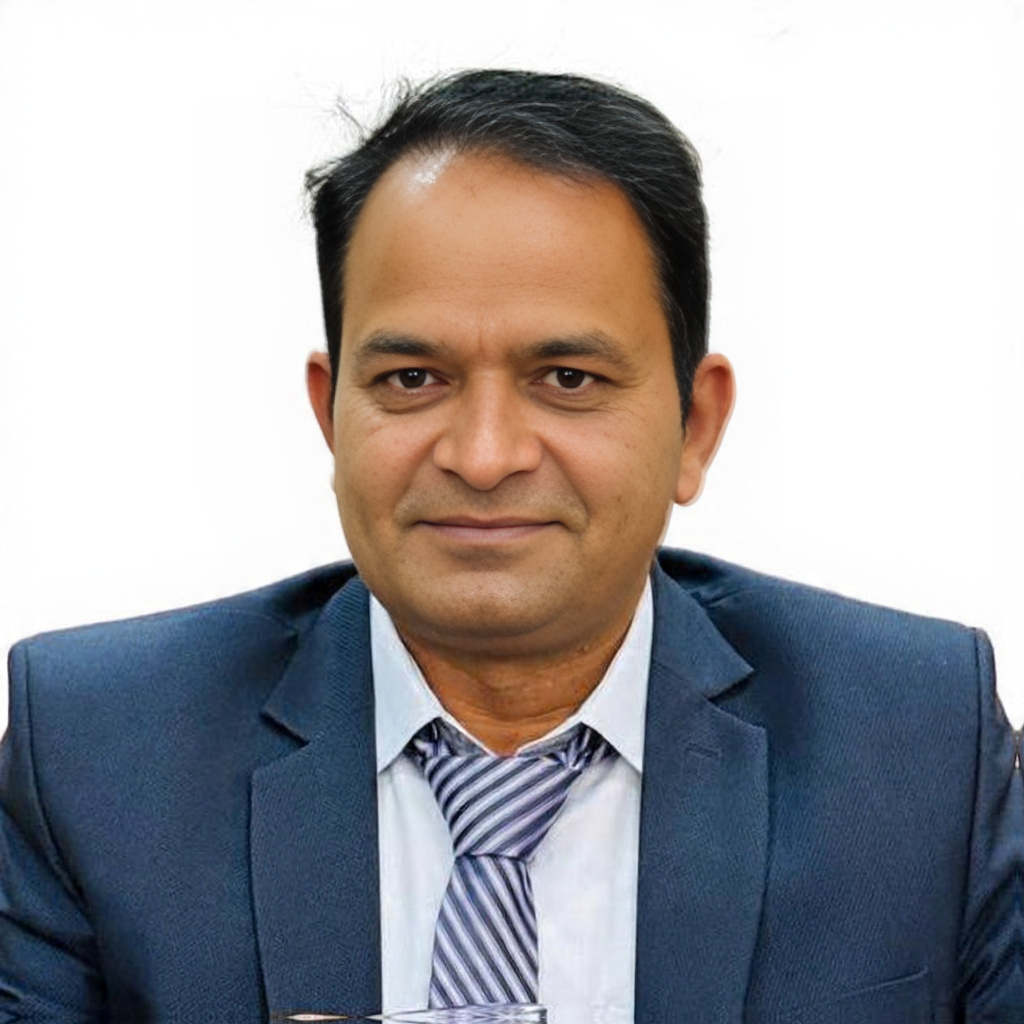
Head of Department (HOD)
Our Experienced Team